Caligidosis (Caligus rogercresseyi)
Overview
What is Caligidosis (Caligus rogercresseyi)?
Caligidosis is the infestation of fish by Caligus rogercresseyi, a sea louse (a copepod of the family Caligidae) endemic to wild fish in the marine and brackish waters of Chile. Described in 2000 by Boxshall and Bravo, it is the main sea louse affecting Chilean salmon farming. It feeds on mucus, skin and blood, which disrupts the osmotic barrier, reduces appetite and feed conversion, and damages the carcass. Treatment alone has been estimated to add USD 1.4 to the cost of each kilogram of salmon produced in Chile.123
It occurs in all farmed salmonids and in native wild fish such as róbalo, pejerrey and lenguado. Atlantic salmon (Salmo salar) and rainbow trout (Oncorhynchus mykiss) are the most susceptible, and coho salmon (Oncorhynchus kisutch) the least. Infestations were first reported in rainbow trout in Los Lagos in the 1980s, in Atlantic salmon in Aysén in the 1990s, and in Magallanes in 2017.123
Its life cycle has eight stages, three of them planktonic (see Causes).12 Temperatures above 4.2 °C and salinities above 24 ppt speed up its development and favour its proliferation.4
Clinical Signs of Caligidosis (Caligus rogercresseyi)
Common Signs
Physical Signs
At its attachment and feeding sites, the parasite can break the skin and cause scale loss, petechiae, ecchymoses, lacerations and, occasionally, eye lesions.4 In experimentally infested Atlantic salmon, fin condition worsened as parasite abundance rose, mainly in the pectoral, pelvic and anal fins.5
Physiological and Behavioural Signs
Infestation disrupts the osmotic barrier of the skin and reduces appetite and feed conversion.3 Under experimental conditions, fin damage was associated with higher plasma glucose and cortisol, both stress indicators, which earlier work linked to more than six adult parasites per fish.5
Secondary Infections
Skin damage opens the way to pathogens and increases susceptibility to bacterial and viral infections.24 The best documented interaction is with Salmonid Rickettsial Septicaemia (SRS), caused by Piscirickettsia salmonis. In a coinfection experiment, Atlantic salmon exposed to P. salmonis and to lice copepodids reached 100% mortality, against 46% (251 of 545 fish) with P. salmonis alone.6 In vaccinated fish, coinfection cut accumulated survival from 42.7% to 5.2% and raised the bacterial load, which may help explain why vaccines perform worse in sea cages.34 On Chilean farms, adult lice abundance over 10 weeks was associated with SRS cumulative mortality over the next 10 weeks, equally in Atlantic salmon and rainbow trout.35 In a 2014 to 2021 cohort, the level of ovigerous females was a key predictor of weekly SRS mortality risk and of the first SRS outbreak of a production cycle.36
In experiments, it transmitted the virus that causes Infectious Salmon Anemia (ISA) to naïve Atlantic salmon even 48 hours after leaving its host, but the virus did not appear to replicate in the louse or reach its larvae. It therefore acts as a mechanical, not a biological, vector, raising the risk of spread within a farm and to other farms in the same hydrographic area.37
Causes of Caligidosis (Caligus rogercresseyi)
Life Cycle
The cycle comprises two planktonic nauplii, the planktonic infective copepodid, four chalimus stages attached to the host by a frontal filament, and adults: males, females without egg sacs and ovigerous females. Eggs released from the egg sacs hatch as nauplii I and restart the cycle.4 The cycle takes about 45 days at 10 °C, 32 days at 12 °C and 26 days at 15 °C. Planktonic stages measure 425 to 658 µm and chalimus stages 830 µm or more.7
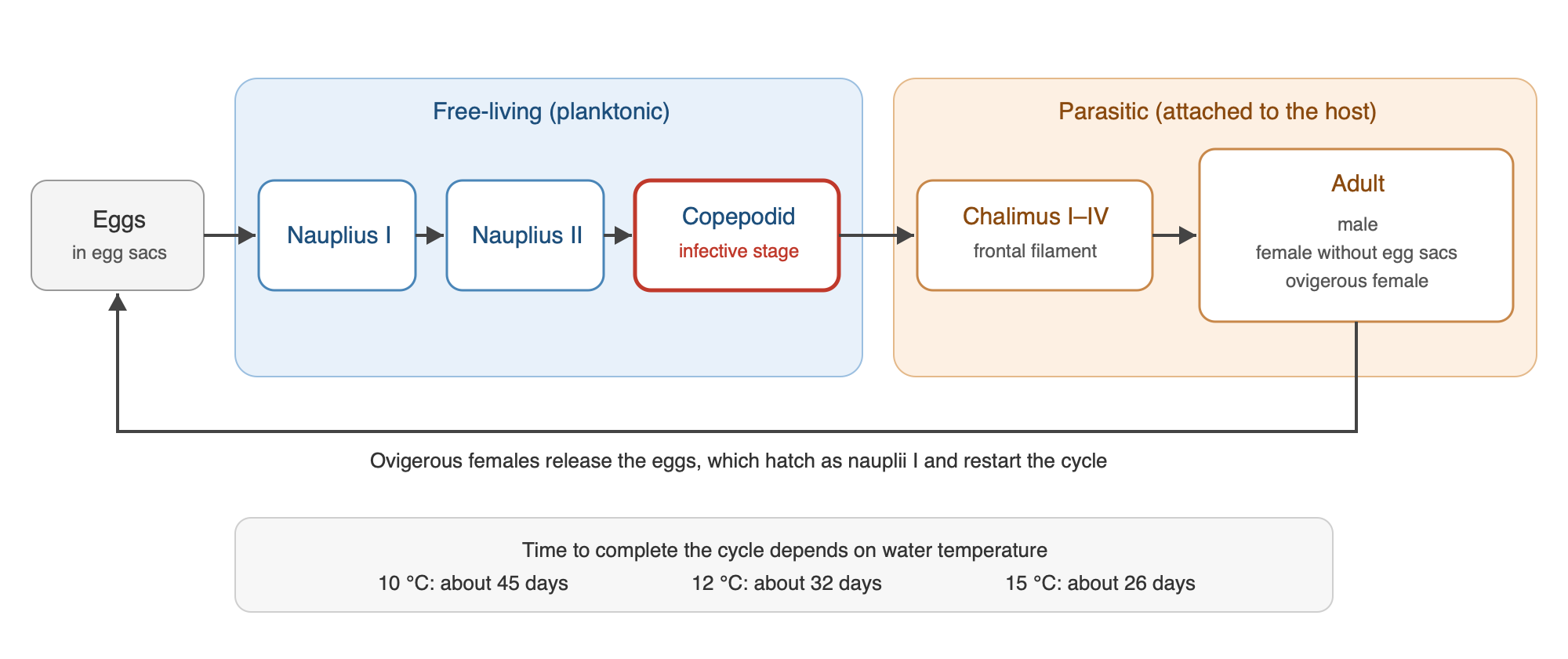 Life cycle of Caligus rogercresseyi: stages, habitat of each stage and time to complete the cycle.
Transmission and Sources of the Parasite
The parasite lives on wild fish such as róbalo, lenguado and pejerrey, free in the plankton, and on farmed salmonids.4 Its larvae disperse through the water column and can reach farms up to 30 km away. Moving live fish by vessel to holding facilities, where they can stay up to 7 days, is an important risk factor for its spread.7 Lice from Chilean farms carry bacteria of the genera Tenacibaculum, Vibrio and Aeromonas, which include the agents of Tenacibaculosis (Tenacibaculum spp), Vibriosis and Furunculosis (Aeromonas spp.), so lice could act as reservoirs of fish pathogens.8
Risk Factors
High stocking densities favour the proliferation and pathogenicity of the parasite.4 Water temperature, salinity and current velocity are the main environmental limits on its distribution in southern Chile, and habitat models project new suitable areas by 2050 and 2100 under climate change.3 The first surveillance programme of the National Fisheries and Aquaculture Service (Sernapesca), in 2007, also linked parasite loads to stocking density and to the treatments applied.7
Diagnosis
Parasite Counts
Diagnosis relies on visual inspection and parasite counts on sampled fish. Lice are counted in three categories: juveniles (chalimus I to IV), mobile adults (males and females without egg sacs) and ovigerous females, which are about 5 mm long and carry egg strings visible to the naked eye. Under the surveillance programme, a qualified sampler does the counts, and the mean number of ovigerous females per fish is used to classify farms (see Regulatory Framework).34
Treatment Efficacy
The efficacy of an immersion treatment is measured by comparing loads in the same 4 cages the day before and 24 to 48 hours after treatment. Low efficacy can reflect a loss of sensitivity, but Sernapesca notes that application errors must be ruled out first, such as dilutions that ignore the technical sheet or tarpaulin dimensions that differ from those used to calculate the dose.7
Resistance Testing
Bioassays measure the sensitivity of a lice population by exposing lice collected from farms to a range of product concentrations. In Los Lagos, they showed increasing resistance to deltamethrin in 2008 and 2012 compared with 2007, before pyrethroids were introduced, and reduced sensitivity to azamethiphos in 2014, a year after its introduction. The F318V variant of the acetylcholinesterase gene AChE1a was associated with survival at high azamethiphos concentrations and is a candidate resistance marker.1415
The Instituto de Fomento Pesquero (IFOP) has monitored antiparasitic resistance since 2017, standardised a simplified bioassay, and leads Sernapesca's official bioassay surveillance. By mid-2026 the programme had accumulated 365 valid bioassays from 117 samplings in 32 farm groupings (ACS). In its ninth stage, presented in June 2026, the median proportion of lice affected by azamethiphos at the therapeutic concentration was 63.7%, a level that has fallen over the stages but is stabilising. Populations remain mostly susceptible to deltamethrin (median about 85%) and to cypermethrin, whose response has been stable since the programme began. Hydrogen peroxide reached about 93%, stable since 2024, and the non-pharmacological product Lyptus Plus exceeded 93%.716
Treatment and Prevention
Pharmacological and Non-Pharmacological Treatments
Chile introduced rules for the integrated pest management of sea lice in 2007, but medicines remain the main control tool, and non-pharmacological treatments have been available since 2016. In 2021, 7.72 g of medicines were prescribed per tonne of harvested salmon, mostly azamethiphos (47%) and hexaflumuron (45.5%), plus 5,532 t of hydrogen peroxide.17
Declining Efficacy
Producer-reported efficacy fell significantly between 2016 and 2021 for the three most used active ingredients. The median efficacy of azamethiphos dropped from 99.4% in 2016 to 70.6% in 2021, and that of deltamethrin from 76.1% in 2016 to 62.3% in 2020. Hydrogen peroxide also declined but kept the highest efficacy, with medians above 88.5%. Sernapesca links the decline to the rising resistance reported in the literature.7
Hydrogen Peroxide
Hydrogen peroxide is applied as an immersion bath. Because of this route of administration, far larger quantities are used than of other antiparasitics (12,947 t in 2025), so its tonnage is not directly comparable with theirs.10 In 20-minute exposures, its EC50 for C. rogercresseyi was 709.8 ppm, and 825 ppm immobilised all lice, so mobile stages are likely to detach from the fish. Males recovered after about 30 minutes and females after about an hour, and recovered lice infested fish as well as unexposed ones. Exposed eggs had lower survival to the copepodid stage.27 In infested Atlantic salmon bathed for 20 minutes at 0, 600, 800 or 1,200 ppm, lice detachment rose with concentration, and females from treated groups produced less viable larvae.28 Variants in cuticle and secretome genes are associated with differences in sensitivity to hydrogen peroxide and may become markers for field monitoring.29
Freshwater Baths
In lice from two farms in Calbuco, 30 minutes in freshwater immobilised all adults, but most recovered in seawater (93% of males, 73% of gravid females and 100% of females without egg strings survived). A 30-minute bath detached only 57% of the lice from infested trout, and females were more tolerant than males.30 A recent trial on juveniles found that exposures longer than 2.5 hours had a 100% effect and about 95% mortality, at least for chalimus III to IV. The authors recommend exceeding 2.5 hours, since surviving juveniles can raise parasite loads and favour resistance to freshwater.31
Coordinated Treatments
Immersion baths have no lasting effect, so lice from neighbouring farms can reinfest treated fish. In Chile, synchronised treatment of neighbouring farms (within 10 km by sea) was associated with lower adult lice levels 5 to 7 weeks after treatment. Official treatment windows coordinate immersion treatments within each farm grouping.418
Genetic Resistance and Vaccines
Resistance to C. rogercresseyi in Atlantic salmon is moderately heritable. In post-smolts from a Chilean breeding programme, the heritability of lice density was 0.28, and three genomic regions explained 7 to 13% of the genetic variation in resistance, which supports selective breeding.19 Vaccines remain experimental. Recombinant cathepsin, alone or mixed with peritrophin, reduced the chalimus burden in Atlantic salmon by 44 to 52%.20 A peptide vaccine based on a Lepeophtheirus salmonis protein reduced adult C. rogercresseyi by 92% in a challenge trial in Chile.21
Case Studies
Establishment of C. rogercresseyi in Magallanes (2017 to 2026)
C. rogercresseyi had been reported in northern Patagonia, between 40°15'S and 49°16'S, where about 90% of Chilean salmon farms are located. In 2017 it was found for the first time on farmed Atlantic salmon in Magallanes, south of 49°16'S. That year 8 farms had at least one louse and 3 behaved as epidemic farms, peaking at 24.5 adult and 14 juvenile lice per fish. Azamethiphos baths sharply reduced the lice on the two most affected farms, but the fish were reinfested within weeks.24
The parasite has since persisted and spread. Lice were reported in 8 farm groupings (ACS) in 2024 and in 10 in 2025, and the regional maximum rose from 0.10 to 0.30 ovigerous females per fish, although the highest weekly prevalence of farms with 3 or more ovigerous females fell from 5.56% to 2.6%.25 Sernapesca has set official treatment coordination windows for Magallanes every year since 2018.32
In May 2026, IFOP reported its first susceptibility bioassays in Magallanes, at two farms. The assays were valid at Isla Capitán Aracena but not at Sector Taraba, where the lice were quickly affected after removal from the fish, possibly because of freshwater influence or low water temperature. IFOP also noted distinctive traits (larger, whiter lice with fewer skin petechiae) and suggests that regional populations may differ genetically and in their response to antiparasitics. It plans to expand monitoring and study population genetics to define management units.26
Lessons Learned: The parasite moved from a first report to repeated detections over several years, while loads stayed far below those of Los Lagos and Aysén. Experts recommend acting while pressure is still low, through early surveillance, biosecurity and coordination among farms, and resistance data from other regions cannot be assumed to apply to Magallanes.
Data Insights
Disease Impact by Country
Chile
Surveillance Programme
Caligidosis is monitored under Sernapesca's Specific Health Programme for the Surveillance and Control of Caligidosis (PSEVC Caligidosis, Resolución Exenta N°60/2022), which covers high-surveillance centres (CAV) farming Atlantic salmon and rainbow trout in Los Lagos, Aysén and Magallanes. A CAV is classified as a high dissemination centre (CAD) when its first monitoring after the official treatment window of its farm grouping shows an average of 3.0 or more ovigerous females (OF) per fish.9
Parasite Loads in 2025
The weekly average load ranged from 1.6 to 3.0 OF in Los Lagos (maximum in weeks 01 and 18, minimum in weeks 45 and 46) and from 1.7 to 3.6 OF in Aysén (maximum in week 42, October). Magallanes stayed far lower, with a maximum of 0.3 OF. Compared with 2024, loads trended slightly down in Los Lagos and slightly up in Aysén, while water temperature remained stable in all three regions.9
Centres Above the Threshold
The weekly share of CAV at 3.0 OF or more ranged from 8.4% (week 49, December) to 25.4% (week 01, January) in Los Lagos and Aysén, and peaked at 2.6% (week 39, September) in Magallanes. Over 2025, 211 CAV reached 3.0 OF or more, mostly in the heaviest production stage (T3, 92 centres or 43.6%). Sernapesca defines the stages by fish weight: T1 is up to 1.5 kg for Atlantic salmon (1.0 kg for rainbow trout and coho salmon), T2 is above that and up to 3.0 kg (2.0 kg), and T3 is above 3.0 kg (2.0 kg).9
| Production stage | Centres with ≥ 3.0 OF in 2024 | Centres with ≥ 3.0 OF in 2025 |
|---|---|---|
| T1 | 49 (23.8%) | 48 (22.7%) |
| T2 | 70 (34.0%) | 71 (33.6%) |
| T3 | 87 (42.2%) | 92 (43.6%) |
Antiparasitic Use in 2025
Sernapesca reports antiparasitic use for the 315 production cycles whose harvest ended in 2025: 195 of Atlantic salmon, 107 of coho salmon and 13 of rainbow trout. These products mainly target C. rogercresseyi. Non-pharmacological immersion treatments rose by 36.1% from 2024 (from 495 to 674 uses). Hydrogen peroxide is reported separately because of its much larger volumes and lower environmental impact, as it breaks down quickly into water and oxygen.10
The other antiparasitics (azamethiphos, emamectin benzoate, deltamethrin and hexaflumuron) totalled 3.03 t, a national index of 2.52 g per tonne produced and 41.26% lower than in 2024. Azamethiphos and hexaflumuron made up 91.2% of this use. All are given as immersion baths except emamectin benzoate, which is given in feed. Use was concentrated in Atlantic salmon and, to a lesser extent, rainbow trout, with none in coho salmon, which Sernapesca links to its lower susceptibility.10
Hydrogen peroxide was applied as immersion baths, only in Atlantic salmon, in Los Lagos and Aysén. The 12,947 t used give an index of 10,795 g per tonne produced, with no significant change from 2024 (0.87%), and Sernapesca considers it an effective, lower-impact option against caligidosis.10
| Species | Closed cycles | Antiparasitics other than hydrogen peroxide (index, g/t) | Hydrogen peroxide (index, g/t) |
|---|---|---|---|
| Atlantic salmon | 195 | 3.51 | 15,491.41 |
| Rainbow trout | 13 | 2.13 | 0 |
| Coho salmon | 107 | 0 | 0 |
| National | 315 | 2.52 | 10,795.09 |
| Region | Closed cycles | Antiparasitics other than hydrogen peroxide (index, g/t) | Hydrogen peroxide (index, g/t) |
|---|---|---|---|
| Los Lagos | 116 | 2.31 | 7,962.14 |
| Aysén | 167 | 3.35 | 16,352.21 |
| Magallanes | 32 | 0.24 | 0 |
Regulatory Framework
Caligidosis is a List 2 high-risk disease in Chile, regulated by the PSEVC Caligidosis (Resolución Exenta N°60/2022). This programme replaced the 2015 one and was amended in 2026 to allow in-situ net cleaning and the return of the liquid fraction from uneaten feed capture systems.411 Treatment windows are official periods, set by Sernapesca for each farm grouping by region and season, within which immersion antiparasitic treatments must be applied. The table summarises what producers must do in each scenario.412
| Scenario | What the producer must do |
|---|---|
| Routine monitoring, every farm | Have a qualified sampler. High-surveillance farms (Atlantic salmon and rainbow trout in Los Lagos, Aysén and Magallanes) count parasites weekly in 6 consecutive cages (4 in Magallanes), 10 fish per cage, and report by the first working day of the following week. Low-surveillance farms, such as coho salmon farms, sample 4 cages monthly. |
| Antiparasitic treatment | Obtain a veterinary prescription through PMV online and treat by immersion in a closed system (tarpaulin or well boat) within the grouping's official window, for no more than 7 days, notifying Sernapesca at least 3 days before the window. Hydrogen peroxide and non-pharmacological treatments are exempt from the window, and since June 2024 so are pharmacological treatments in watertight vessels, although post-window monitoring and reporting still apply.33 Submit a post-treatment efficacy report within 2 working days. |
| Choice of active ingredient | The same chemical family can be used at most 3 consecutive times per production cycle, and rotation requires another family, a non-pharmacological option or hydrogen peroxide. Immersion pyrethroids and organophosphates are capped per farm and cycle, for example at 43 kg of active ingredient in the highest-use groupings of Los Lagos and Aysén and 23 kg in Magallanes (from February 2024 for those groupings and February 2025 for the rest). |
| First monitoring after the treatment window at 3.0 OF or more (high dissemination centre) | Apply control measures in the next window. Three consecutive classifications require harvesting 50% of the biomass within 21 days, and three within 6 consecutive evaluations require harvesting 25%, with the harvest plan due within 48 hours of notification. |
| Ways to avoid that classification | Sernapesca can exempt farms facing adverse environmental conditions or exceptional health situations. A non-pharmacological treatment covering at least 50% of the populated cages can exclude the farm at the next evaluation, and a voluntary harvest plan (at least 15% of the biomass within 21 days, once per cycle) suspends the classification while it runs. |
| Harvest from a cage at 9.0 OF or more | Fish cannot stay in a floating holding facility and must go directly to the plant, to a land-based holding facility, or stay no more than 72 hours, otherwise Sernapesca can suspend the sanitary movement certificates. |
Antiparasitic Use and Efficacy in 2018
According to the technical report cited in Resolución Exenta N°594, five active ingredients were registered against C. rogercresseyi: azamethiphos, cypermethrin and deltamethrin, used as immersion baths at sea, and lufenuron and emamectin benzoate, used in freshwater or at sea stocking. In 2018, 1,396 immersion treatments were reported, 77% with azamethiphos, while hydrogen peroxide, then under a special use authorisation, accounted for less than 0.05%. Azamethiphos was the most effective, followed by deltamethrin, but its average efficacy, which had ranged from 90 to 100% in 2016-2017, was declining, with some areas reporting 80% or less.13
Research and References
Latest Research Findings
Dispersal Modelling
IFOP's open-access CHONOS platform includes MOSA, an operational oceanographic model for southern Chile that forecasts currents, temperature and salinity 3 and 10 days ahead, and PARTIMOSA, a particle-tracking tool whose Caligus module accounts for active swimming and environmental mortality to estimate the risk of dispersal between neighbouring farms. Sernapesca uses hydrodynamic modelling to define pathogen containment measures and to support the redesign of farm groupings (ACS).22
The CLIC module of CHONOS shows connectivity matrices between salmon farm concessions for the planktonic stages of C. rogercresseyi (nauplius and infective copepodid). Its individual-based model includes maturation between larval stages, mortality, and day-night vertical migration between the surface and the halocline, avoiding low-salinity waters linked to high mortality.23
Conclusion
Caligidosis is the main parasitic disease of Chilean salmon farming, and its control still relies largely on antiparasitic baths whose efficacy has fallen as C. rogercresseyi has lost sensitivity, most clearly to azamethiphos. Effective management combines load monitoring and resistance bioassays, rotation and use limits for active ingredients, non-pharmacological options, and treatments coordinated within each farm grouping, since lice from neighbouring farms can reinfest treated fish. Lice also worsen SRS and can spread ISA virus, so their control supports wider health management. In Magallanes, where loads remain low, early surveillance still offers a window to act. Selective breeding, vaccines and dispersal models are promising complements, but most remain experimental or support planning rather than replacing current tools.
Call to Action
For more information on managing fish diseases and enhancing fish health, subscribe to our newsletter and follow our latest research updates.
Last Modified: 2026-11-02
Other Parasitic Diseases
Amoebic Gill Disease (AGD) Gyrodactylus salaris Paranucleosporosis Parvicapsulosis Proliferative Gill Disease Saprolegniasis Sea Lice
Citations: [1] Servicio Nacional de Pesca. (2012). Resolución Exenta N°1.141: Establece Programa Sanitario Específico de Vigilancia y Control de Caligidosis (PSEVC-Caligidosis). Deja sin efecto Resolución N°2.117 exenta, de 2009. https://faolex.fao.org/docs/pdf/chi112982.pdf
[2] Cáceres, P., Barría, A., Christensen, K. A., Bassini, L. N., Correa, K., Garcia, B., Lhorente, J. P., & Yáñez, J. M. (2021). Genome-scale comparative analysis for host resistance against sea lice between Atlantic salmon and rainbow trout. Scientific Reports, 11, Article 13231. https://doi.org/10.1038/s41598-021-92425-3
[3] Lepe-Lopez, M., Escobar-Dodero, J., Zimin-Veselkoff, N., Azat, C., & Mardones, F. O. (2021). Assessing the present and future habitat suitability of Caligus rogercresseyi (Boxshall and Bravo, 2000) for salmon farming in southern Chile. Frontiers in Veterinary Science, 7, Article 615039. https://doi.org/10.3389/fvets.2020.615039
[4] Servicio Nacional de Pesca y Acuicultura. (2022). Resolución Exenta N°60: Aprueba Programa Sanitario Específico de Vigilancia y Control de Caligidosis. Deja sin efecto Resolución Exenta número 13 de 2015. http://www.sernapesca.cl/sites/default/files/res.ex_.60-2022.pdf
[5] González, M. P., Marín, S. L., Mancilla, M., Cañon-Jones, H., & Vargas-Chacoff, L. (2020). Fin erosion of Salmo salar (Linnaeus 1758) infested with the parasite Caligus rogercresseyi (Boxshall & Bravo 2000). Animals, 10(7), Article 1166. https://doi.org/10.3390/ani10071166
[6] Lhorente, J. P., Gallardo, J. A., Villanueva, B., Carabaño, M. J., & Neira, R. (2014). Disease resistance in Atlantic salmon (Salmo salar): Coinfection of the intracellular bacterial pathogen Piscirickettsia salmonis and the sea louse Caligus rogercresseyi. PLOS ONE, 9(4), Article e95397. https://doi.org/10.1371/journal.pone.0095397
[7] Servicio Nacional de Pesca y Acuicultura. (2022). Informe técnico: Nuevo programa de vigilancia y control de caligidosis. Sernapesca, Subdirección de Acuicultura, Departamento de Salud Animal. https://www.sernapesca.cl/app/uploads/2024/01/INFORME-TECNICO-PSEVC-CALIGIDOSIS-ENERO-2022.pdf
[8] Gonçalves, A. T., Collipal-Matamal, R., Valenzuela-Muñoz, V., Nuñez-Acuña, G., Valenzuela-Miranda, D., & Gallardo-Escárate, C. (2020). Nanopore sequencing of microbial communities reveals the potential role of sea lice as a reservoir for fish pathogens. Scientific Reports, 10, Article 2895. https://doi.org/10.1038/s41598-020-59747-0
[9] Servicio Nacional de Pesca y Acuicultura. (2026). Informe sobre la situación sanitaria de la salmonicultura en Chile, año 2025. Sernapesca. https://www.sernapesca.cl/app/uploads/2026/03/Informe-Situacion-Sanitaria-Salmonicultura-Ano-2025.pdf
[10] Servicio Nacional de Pesca y Acuicultura. (2026). Informe de uso de antimicrobianos y antiparasitarios, año 2025. Sernapesca, Subdirección de Acuicultura, Departamento de Salud Animal. https://www.sernapesca.cl/app/uploads/2026/03/Informe-de-uso-de-antimicrobianos-ano-2025.pdf
[11] Servicio Nacional de Pesca y Acuicultura. (2026). Resolución Exenta N° DN-02385/2026: Modifica Programa Sanitario Específico de Vigilancia y Control de la Caligidosis, aprobado mediante Resolución Exenta N°60 de fecha 02 de febrero de 2022. https://www.sernapesca.cl/app/uploads/2026/09/RES-EX-N%C2%B0-2385-30-07-26-Modifica-PSEVC-caligidosis.pdf
[12] Servicio Nacional de Pesca y Acuicultura. (2024). Límites máximos de uso de antiparasitarios. https://www.sernapesca.cl/app/uploads/2024/01/Limites-maximos-de-uso-de-antiparasitarios.pdf
[13] Servicio Nacional de Pesca y Acuicultura. (2019). Resolución Exenta N°594: Modifica Resolución Exenta N°13, de 2015, que establece Programa Sanitario Específico de Vigilancia y Control de la Caligidosis (PSEVC-Caligidosis). https://www.subpesca.cl/portal/617/articles-103570_recurso_2.pdf
[14] Helgesen, K. O., Bravo, S., Sevatdal, S., Mendoza, J., & Horsberg, T. E. (2014). Deltamethrin resistance in the sea louse Caligus rogercresseyi (Boxhall and Bravo) in Chile: Bioassay results and usage data for antiparasitic agents with references to Norwegian conditions. Journal of Fish Diseases, 37(10), 877–890. https://doi.org/10.1111/jfd.12223
[15] Agusti-Ridaura, C., Dondrup, M., Horsberg, T. E., Leong, J. S., Koop, B. F., Bravo, S., Mendoza, J., & Kaur, K. (2018). Caligus rogercresseyi acetylcholinesterase types and variants: A potential marker for organophosphate resistance. Parasites & Vectors, 11, Article 570. https://doi.org/10.1186/s13071-018-3151-7
[16] Appel, L. (2026, June 30). Vigilancia confirma cambios en la susceptibilidad de Caligus a antiparasitarios. Salmonexpert. https://www.salmonexpert.cl/antiparasitarios-caligus-caligus-rogercresseyi/vigilancia-confirma-cambios-en-la-susceptibilidad-de-caligus-a-antiparasitarios/2145716
[17] Bravo, S., & Treasurer, J. (2023). The management of the sea lice in Chile: A review. Reviews in Aquaculture, 15(4), 1749–1764. https://doi.org/10.1111/raq.12815
[18] Arriagada, G., Stryhn, H., Sanchez, J., Vanderstichel, R., Campistó, J. L., Rees, E. E., Ibarra, R., & St-Hilaire, S. (2017). Evaluating the effect of synchronized sea lice treatments in Chile. Preventive Veterinary Medicine, 136, 1–10. https://doi.org/10.1016/j.prevetmed.2016.11.011
[19] Robledo, D., Gutiérrez, A. P., Barría, A., Lhorente, J. P., Houston, R. D., & Yáñez, J. M. (2019). Discovery and functional annotation of quantitative trait loci affecting resistance to sea lice in Atlantic salmon. Frontiers in Genetics, 10, Article 56. https://doi.org/10.3389/fgene.2019.00056
[20] Casuso, A., Valenzuela-Muñoz, V., Benavente, B. P., Valenzuela-Miranda, D., & Gallardo-Escárate, C. (2022). Exploring sea lice vaccines against early stages of infestation in Atlantic salmon (Salmo salar). Vaccines, 10(7), Article 1063. https://doi.org/10.3390/vaccines10071063
[21] Johny, A., Ilardi, P., Olsen, R. E., Egelandsdal, B., & Slinde, E. (2024). A proof-of-concept study to develop a peptide-based vaccine against salmon lice infestation in Atlantic salmon (Salmo salar L.). Vaccines, 12(5), Article 456. https://doi.org/10.3390/vaccines12050456
[22] Naguil, D. (2026, September 27). IFOP: Oceanografía clave para la salmonicultura. InfoSalmon. https://infosalmon.cl/ifop-modelacion-oceanografica-salmonicultura-acs/
[23] Instituto de Fomento Pesquero. (n.d.). CLIC, conectividad lagrangiana. CHONOS. http://chonos.ifop.cl/wiki/clic-conectividad-lagrangiana/
[24] Arriagada, G., Valenzuela-Muñoz, V., Arriagada, A. M., Núñez-Acuña, P., Brossard, M., Montecino, K., Lara, M., Gallardo, A., & Gallardo-Escárate, C. (2019). First report of the sea louse Caligus rogercresseyi found in farmed Atlantic salmon in the Magallanes region, Chile. Aquaculture, 512, Article 734386. https://doi.org/10.1016/j.aquaculture.2019.734386
[25] Radio Polar. (2026, August 10). De evento esporádico a riesgo presente: Caligus comienza a instalarse en Magallanes para quedarse. https://www.radiopolar.com/evento-esporadico-riesgo-presente-caligus-comienza-instalarse-magallanes-quedarse
[26] Maldonado, I. (2026, May 4). Primeros bioensayos de Caligus en Magallanes revelan nuevos desafíos sanitarios del salmón. Salmonexpert. https://www.salmonexpert.cl/bioensayos-caligidosis-caligus/primeros-bioensayos-de-caligus-en-magallanes-revelan-nuevos-desafios-sanitarios-del-salmon/2114987
[27] Marín, S. L., González, M. P., Madariaga, S. T., Mancilla, M., & Mancilla, J. (2018). Response of Caligus rogercresseyi (Boxshall & Bravo, 2000) to treatment with hydrogen peroxide: Recovery of parasites, fish infestation and egg viability under experimental conditions. Journal of Fish Diseases, 41(6), 861–873. https://doi.org/10.1111/jfd.12691
[28] Valenzuela-Muñoz, V., Gallardo-Escárate, A., Sáez-Vera, C., Garcés, F., Bonfatti, J., & Gallardo-Escárate, C. (2020). More than bubbles: In vivo assessment and transcriptome modulation of Caligus rogercresseyi and Atlantic salmon exposed to hydrogen peroxide (PARAMOVE®). Aquaculture, 522, Article 735170. https://doi.org/10.1016/j.aquaculture.2020.735170
[29] Sáez-Vera, C., Núñez-Acuña, G., & Gallardo-Escárate, C. (2023). Single nucleotide polymorphisms in cuticle and secretome-related genes are associated with hydrogen peroxide sensitivity in the sea louse Caligus rogercresseyi. Aquaculture, 571, Article 739470. https://doi.org/10.1016/j.aquaculture.2023.739470
[30] Bravo, S., Pozo, V., & Silva, M. T. (2015). Assessment of the freshwater treatment to control the sea lice Caligus rogercresseyi Boxshall & Bravo, 2000. Latin American Journal of Aquatic Research, 43(2), 322–328. https://doi.org/10.3856/vol43-issue2-fulltext-8
[31] Mancilla-Schulz, J., Vivar, D., Santana, J., Peralta, A., Schulze, F., Espinoza, M., & González-Gómez, M. P. (2026). Effectiveness of freshwater on Caligus rogercresseyi juveniles. Journal of Fish Diseases, 49(3), Article e70045. https://doi.org/10.1111/jfd.70045
[32] Servicio Nacional de Pesca y Acuicultura. (n.d.). Ventanas oficiales de coordinación tratamientos inmersión Caligus. https://www.sernapesca.cl/informacion-utilidad/ventanas-oficiales-de-coordinacion-tratamientos-inmersion-caligus/
[33] Servicio Nacional de Pesca y Acuicultura. (2024). Resolución Exenta N° DN-01272/2024: Autoriza excepcionalmente el tratamiento farmacológico de la caligidosis, fuera de las ventanas de baño oficiales, cuando sea desarrollado en embarcaciones estancas. https://www.sernapesca.cl/app/uploads/2024/07/1272-2024.pdf
[34] Figueroa, C., Bustos, P., Torrealba, D., Dixon, B., Soto, C., Conejeros, P., & Gallardo, J. A. (2017). Coinfection takes its toll: Sea lice override the protective effects of vaccination against a bacterial pathogen in Atlantic salmon. Scientific Reports, 7, Article 17817. https://doi.org/10.1038/s41598-017-18180-6
[35] Arriagada, G., Hamilton-West, C., Nekouei, O., Foerster, C., Müller, A., Lara, M., & Gallardo-Escárate, C. (2019). Caligus rogercresseyi infestation is associated with Piscirickettsia salmonis-attributed mortalities in farmed salmonids in Chile. Preventive Veterinary Medicine, 171, Article 104771. https://doi.org/10.1016/j.prevetmed.2019.104771
[36] Diethelm-Varela, B., Atero, N., Córdova-Bührle, F., Rezende, E. L., Gelcich, S., Sandoval, O., Navarro, C., & Mardones, F. O. (2026). Epidemiology of salmonid rickettsial septicemia (SRS) in farmed salmon: The role of sea lice infestations in mortality risk. Journal of Fish Diseases, 49(5), Article e70097. https://doi.org/10.1111/jfd.70097
[37] Oelckers, K., Vike, S., Duesund, H., Gonzalez, J., Wadsworth, S., & Nylund, A. (2014). Caligus rogercresseyi as a potential vector for transmission of Infectious Salmon Anaemia (ISA) virus in Chile. Aquaculture, 420–421, 126–132. https://doi.org/10.1016/j.aquaculture.2013.10.016